How-To Creole

How-To Creole provides simple lessons and videos to help you learn Haitian Creole

How-To Creole Pronunciation Lessons ☰

How to Introduce Yourself and Others in Haitian Creole

Beginner Lessons

What You Will Learn


In this lesson, you will learn the following:

1. How to introduce yourself to someone

2. How to ask someone to introduce themselves

3. How to introduce someone else to other people

How to Introduce Yourself to Someone

  • 1. To tell someone your name in Haitian Creole, say Mwen rele or Non mwen se, and then say your name.
  • 2. To tell someone where you are from, say Mwen soti or Mwen sot, and then say the place you are from.
  • 3. To tell someone what you do, say Mwen se yon, and then say your job, role, or profession.
Introducing yourself to someone in Haitian Creole

Example 1


Saying your name


Mwen rele Ronel.

My name is Ronel.


Example 2


Saying where you are from


Mwen soti Ayiti.

I am from Haiti.


Example 3


Saying what you do for work


Mwen se yon pwofesè.

I am a teacher.


How to Ask Someone to Introduce Themselves

  • 1. To ask someone for their name in Haitian Creole, say Kòman ou rele? or Kijan ou rele?
  • 2. To ask someone where they are from, say Ki kote ou soti?
  • 3. To ask someone what they do for work, say Ki travay ou fè? or Kisa ou fè?
Asking someone to introduce themselves in Haitian Creole

When asking where someone is from, you can also be more specific by asking about their country or city.


Ki peyi ou soti?

What country are you from?


Nan ki vil ou soti?

What city are you from?


How to Introduce Someone Else to Other People

  • 1. To introduce someone else, say Li rele, and then say the person's name.
  • 2. To say where someone else is from, say Li soti or Li sot, and then say where the person is from.
  • 3. To say what someone else's job is, say Li se yon, and then say the name of the job or profession.

Note: In Haitian Creole, li can mean he or she, depending on the person you are talking about.

Introducing someone else to other people in Haitian Creole

Example 1


Saying someone else's name


Li rele Jenny.

Her name is Jenny.


Example 2


Saying where someone else is from


Li sot Kanada.

She is from Canada.


Example 3


Saying what someone else does for work


Li se yon enfimyè.

She is a nurse.


It Starts With a Greeting


A simple greeting is a great way to start a conversation with someone who speaks Haitian Creole. Please see our lessons on using greetings and asking basic questions in Haitian Creole.

Helpful Lessons


Greetings in Haitian Creole

Asking Questions in Haitian Creole

How to Pronounce Complete Words in Haitian Creole

Pronunciation Guide

Haitian Creole Spelling Is Highly Phonetic


In standard Haitian Creole spelling, words are usually pronounced very closely to the way they are written.

Haitian Creole has no silent letters, and each written sound has a clear purpose. However, some sounds are written with more than one letter, such as ch, ou, an, en, and on.

Three Golden Rules You Should Know

  • 1. Pronounce each written sound clearly.
  • 2. Pay attention to letter combinations, because some sounds are written with two or three letters.
  • 3. Haitian Creole has no silent letters in standard spelling.

How to Pronounce Complete Words in Haitian Creole

Because Haitian Creole spelling is highly regular and has no silent letters, you can often pronounce new words by identifying the sound units and putting them together.

Example showing how to pronounce the Haitian Creole word labou by breaking it into syllables.

Steps to Pronouncing Words in Haitian Creole


See our Haitian Creole pronunciation guide to learn how to pronounce Creole vowels, nasal vowels, consonants, and letter combinations.


1. Break the word into sound units. Look for vowels, consonants, and common letter combinations such as ch, ou, an, en, and on. As a beginner, practice out loud so you can hear the sounds clearly.

2. Combine the sound units into syllables. This helps you form larger parts of the word. For example, the word labou, which means mud, has two syllables: la and bou. Take time to pronounce each syllable.

3. Combine the syllables into a word. Using the word labou from above, the pronunciation is roughly la-boo for English speakers.

4. Repeat and practice regularly. Practice until you feel comfortable with the word. Use this same method for new words you encounter while reading in Creole. In time, you will be able to read and speak with more fluency.

Practice Makes Progress


Although Haitian Creole pronunciation rules are relatively regular, you still need to make a sincere effort to read and pronounce words correctly. The diagram and the steps above are helpful strategies for learning how to pronounce words in Creole.

If you have already made great progress in Creole and can speak it fluently, do not underestimate the importance of reading and writing. Literacy in a language involves both reading and writing, not just speaking.

How to Pronounce Vowels in Haitian Creole

Pronunciation Guide

What You Will Learn


You will learn how to pronounce the basic Haitian Creole vowels.

You will also learn how to pronounce distinctive vowel combinations such as ay, anm, enn, and others.

How to Pronounce the Basic Haitian Creole Vowels

  • Many Haitian Creole vowels have close English approximations, but some sounds do not match English exactly.

The illustration below shows how to pronounce the basic Haitian Creole vowel sounds.

Focus on the green letters, because they will help you pronounce the vowels correctly.

Basic Haitian Creole vowel pronunciation examples.

How to Pronounce Nasal Vowels Written with “n”

  • Some Haitian Creole vowel sounds are nasal, which means air passes partly through the nose when you pronounce them.
  • Please watch the video to hear how these sounds are pronounced.

Several common Haitian Creole vowel sounds are written with the letter n, such as an, en, on, and oun.

When these spellings represent nasal vowels, the n is usually not pronounced as a separate English-style n. Instead, it helps mark the nasal vowel sound.

Try to notice the difference between nasal vowel sounds such as an, en, on, and oun, and non-nasal combinations where the n is pronounced more clearly.

Haitian Creole nasal vowel sounds written with n.

How to Pronounce Other Common Vowel Combinations

  • Pay close attention to the sounds ay and anm. They are common in Haitian Creole.
Other common Haitian Creole vowel combinations.

A Few Things to Keep in Mind


1. The accented letter à is not shown as a separate basic vowel in the first list because it is very rare in standard Haitian Creole spelling.

2. In standard spelling, à is most often seen in the combination àn. The accent helps show that the a is pronounced as an oral vowel before n, rather than as the nasal vowel an.

3. The sound àn is rare in Haitian Creole. It sounds roughly like the English name Ann or Anne.

Because this sound is uncommon, you may not see it often, even when reading many pages of Haitian Creole text.

How to Say the Colors in Haitian Creole

Beginner Lessons

What You Will Learn


1. You will learn how to say the basic colors in Haitian Creole.

2. You will learn how to say different color shades, such as light blue and dark blue.

How to Say the Basic Colors

  • Many Haitian Creole color words are similar to French, although the spelling and pronunciation are often different.
Basic colors in Haitian Creole include wouj (red), ble (blue), vèt (green), jòn (yellow), woz (pink), mawon (brown), mov (purple), zoranj (orange), blan (white), gri (gray), and nwa (black).

How to Say the Colors When Speaking

  • When describing an object by its color, put the color after the noun.

Consider These Examples


Notice how the color appears after the object.


1. Machin wouj — Red car

2. Fèy vèt — Green leaf

3. Syèl ble — Blue sky


How to Say Light and Dark Color Shades

  • 1. Say klè for lighter color shades.
  • 2. Say fonse for darker color shades.
  • 3. Say the shade word after the main color.
Examples of light and dark color shades in Haitian Creole.

Consider These Examples


Notice how both the main color and the shade word appear after the object.


1. Fèy vèt klè — Light green leaf

2. Fèy vèt fonse — Dark green leaf


Focus on the Basic Colors


In everyday conversation, Haitian Creole speakers often use the basic color term instead of a more specific shade.

So, if you are learning Haitian Creole, focus on the main colors shown in this lesson first.

That will be enough for many everyday conversations with native speakers.

How to Use Accent Marks in Haitian Creole

Pronunciation Guide

Haitian Creole Has One Accent Mark in Standard Orthography


Standard Haitian Creole orthography uses only the grave accent mark. It looks like a small line that slants to the left: (`).

This lesson will show you how to pronounce letters with the grave accent mark.

You will also learn how to type the grave accent mark on a physical keyboard or a touchscreen.

How the Grave Accent Mark Works

  • In standard Haitian Creole spelling, the grave accent mark appears on the letters a, e, and o.

When the grave accent mark is placed above those letters, they look like this: à, è, ò.

Continue reading below to see how to pronounce them.

  • Focus mainly on the accented letters è and ò.

The accented letter à is very rare in standard Haitian Creole spelling.

In standard spelling, à is usually seen in the combination àn. (See the first example below.)

How to Pronounce Haitian Creole Accent Marks


1. Àn - sounds roughly like the vowel in the English name Ann.

2. È - sounds roughly like the e in Get.

3. Ò - sounds roughly like the vowel sound in order or aught.


How to Type Haitian Creole Accent Marks on a Touchscreen

  • On many phones and tablets, long-press the letters a, e, or o, and then choose the one with the grave accent.
Haitian Creole accent marks on a touchscreen.

On many touchscreen keyboards, long-pressing the letters a, e, or o gives you the option to add the grave accent mark.


Note: On many Mac computers, you can also press and hold a letter key to bring up accented options.


On Windows, another option is to enable the on-screen touch keyboard and select accented letters there.


How to Type Haitian Creole Accent Marks on a Keyboard

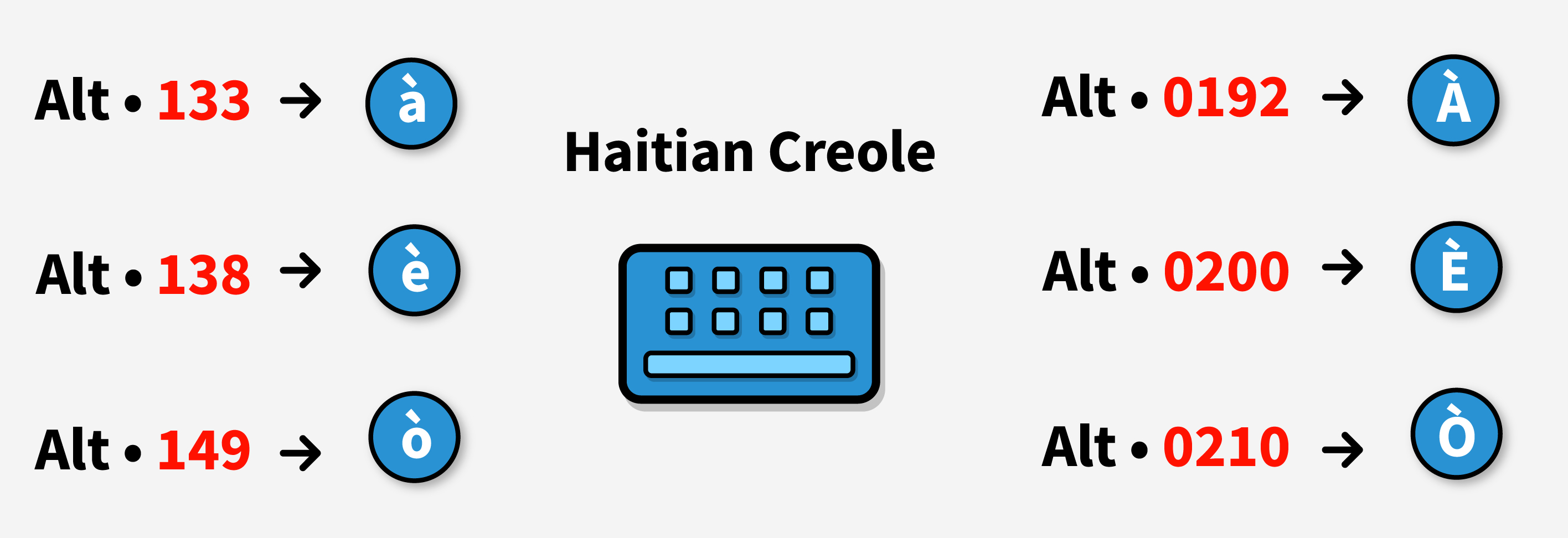
  • On many Windows PCs, you can press and hold Alt and then type the numbers on the numeric keypad. (See the image below.)

If your keyboard does not have a numeric keypad, using the touch keyboard or an international keyboard layout may be easier.

Haitian Creole accent marks keyboard shortcuts

Haitian Creole accent marks keyboard shortcuts.

Focus Mainly on è and ò


As mentioned earlier, the letter à is very rare in standard Haitian Creole spelling.

So, focus on learning how to pronounce è and ò first.

How the Haitian Creole Alphabet Works

Pronunciation Guide

What You Will Learn


This lesson introduces the Haitian Creole alphabet and some of its most important spelling features.

It will make it easier for you to read and write in Creole.

Haitian Creole Alphabet


a an b ch d e è en f g h i j k l m n ng o ò on ou oun p r s t ui v w y z

Key Features of the Haitian Creole Alphabet

  • In standard Haitian Creole spelling, the letters c and u are not used on their own.

1. In standard spelling, you will usually see the letter c only next to h, in the form ch.


Examples

Chalè (Heat), Chante (Sing), Chita (Sit down)


2. In standard spelling, you will usually see the letter u next to o or i, in the forms ou, oun, or ui.


Examples

Out (August), Moun (People), Uit (Eight)


  • The letters q and x are not part of standard Haitian Creole orthography.

1. When words are written in standard Haitian Creole spelling, the sounds often written with q or qu in other languages are usually written with k or kw, depending on the word.


Examples

Kesyon (Question), Kalite (Quality), Kwizin (Kitchen)


2. The letter x is also not part of standard Haitian Creole spelling. In words of foreign origin, its sound is often written with ks or sometimes gz, depending on pronunciation.


Examples

Tèks (Text), Klowòks (Bleach), Egzamen (Exam)


Foreign names, brand names, and very recent loanwords may not always follow these patterns exactly.

Learn How to Pronounce Words in Haitian Creole


As you have seen in this lesson, Haitian Creole spelling is relatively regular and straightforward. Still, it is important to learn how these letters and letter combinations are pronounced in real words.

This lesson is only part one of a complete pronunciation series. After reviewing this lesson, please visit our Haitian Creole pronunciation guide.

Is Haitian Creole Easy to Learn?

Beginner Lessons Haitian Creole can be an approachable language to learn

3 Reasons Why Haitian Creole Is Easy to Learn


1. Its spelling and pronunciation are relatively consistent. Haitian Creole has a highly regular writing system. In general, words are pronounced much closer to the way they are written than in English, and there are no silent letters. That said, learners still need practice with sounds such as nasal vowels and letters like è and ò.

For example, in English, the word live can be pronounced differently depending on whether you mean a live broadcast or a place where someone lives. Haitian Creole spelling is much more consistent, which makes pronunciation easier for beginners.

2. Verbs are easier to work with. Haitian Creole has very little verb conjugation. In many cases, the verb stays the same regardless of the subject, while tense and aspect are shown with markers placed before the verb. For instance, the verb pale (to speak) remains the same regardless of who you are referring to.

  • Consider these examples
  • Mwen pale → I speak
  • Ou pale → You speak
  • Li pale → He/She speaks
  • Nou pale → We speak
  • Yo pale → They speak

The word se is also important in Haitian Creole, but it is not best taught as a simple stand-alone equivalent of every English form of to be. For example, Li se yon pwofesè means He/She is a teacher.

3. You usually do not have to worry about grammatical gender. Like English, Haitian Creole nouns generally do not have grammatical gender. In some languages, each noun is treated as masculine or feminine. For example, in French and Spanish, the word "apple" is feminine (la pomme, la manzana). This is not the case in Haitian Creole; an apple is simply yon pòm.

Is Haitian Creole Worth Learning?


Yes. Haitian Creole is one of Haiti's official languages and the first language of most Haitians. It is also widely spoken in Haitian communities abroad, especially in places such as Florida, New York, and Massachusetts.

That makes Haitian Creole a practical language to learn for communication, community work, education, healthcare, interpreting, business, and cultural connection. If you live in or work with Haitian communities, learning Haitian Creole is a very good idea.

The History of Haitian Creole - A Closer Look

Beginner Lessons Learn the history of Haitian Creole.
Though it is a relatively young language, Haitian Creole has a rich history.

When Christopher Columbus arrived on the island of Hispaniola in 1492, the people living there were not speaking Haitian Creole, and there was not yet a Haitian people in the modern sense. Haitian Creole developed later, during the French colonial period in Saint-Domingue, especially in the 17th and 18th centuries.

That was enough time for a new language to emerge and, eventually, for a distinct Haitian culture to take shape. Drawing much of its vocabulary from French while also being shaped by West and Central African languages, Haitian Creole has a relatively short but fascinating history. This article explains how Haitian Creole formed, where it stands today, and how it may continue to develop in the future.

Haitian Creole - How Did It Begin?

Every major language has a history, and Haitian Creole is no different. During the colonial period, many enslaved Africans were brought to the western part of Hispaniola, which later became Haiti. Because they came from different ethnic groups and language backgrounds, they often did not share a common language when they first arrived.

Main Languages that Influenced Haitian Creole


French. If you know some French, you will quickly notice similarities between French and Haitian Creole. A large portion of Haitian Creole vocabulary comes from French, although the pronunciation, grammar, and sentence structure often differ significantly.

West and Central African languages. Despite those similarities in vocabulary, French and Haitian Creole often sound very different. One reason is that Haitian Creole was shaped not only by French, but also by several West and Central African languages. These include Gbe languages such as Fon and Ewe, as well as Kongo languages. Those influences helped shape the sound system, grammar, and rhythm of Haitian Creole.

Taíno and others. The Taíno people of Hispaniola suffered catastrophic population losses after European colonization because of violence, forced labor, and disease. As a result, Taíno did not shape Haitian Creole as heavily as French and African languages did, but it still left traces in the vocabulary. For example, words such as anana (pineapple) are commonly linked to Taíno roots. Spanish also had a more limited influence on the language.

Haitian Creole is influenced by African languages such as Ewe and Fon.
In addition to French, Haitian Creole was shaped by several African languages, including Fon, Ewe, and Kongo languages.

In Saint-Domingue, enslaved Africans and colonists needed some way to communicate. Over time, a new contact language developed out of that colonial setting. The French that influenced Haitian Creole was not identical to modern standard French; it included regional and nonstandard varieties spoken in colonial society.

African and, to a lesser extent, Taíno and Spanish influences also helped shape the language. Together, those influences contributed to the emergence of Haitian Creole as a distinct language rather than a mere version of French.

Because present-day Haiti occupied the French-controlled western part of Hispaniola, French was the main source of most Haitian Creole vocabulary.

However, because Haitian Creole developed under different social and linguistic conditions, its grammar and overall structure differ significantly from standard French. For that reason, native speakers of French who have never studied Haitian Creole usually cannot fully understand it.

Haitian Creole Today - Growing in Visibility

Haitian Creole remains the first language of the great majority of Haitians and is one of the two official languages of Haiti, alongside French. Over the past several decades, it has gained greater visibility in education, media, literature, public life, and digital spaces.

Many Indigenous languages throughout the Americas declined sharply after European colonization because of violence, disease, forced displacement, and language suppression. Haitian Creole, however, continued to grow as the everyday language of the Haitian people. Today, it remains vibrant in Haiti and in Haitian communities abroad.

Haitian Creole - From Stigmatization to Greater Acceptance

For a long time, Haitian Creole was stigmatized by many elites, even though the overwhelming majority of Haitians spoke it as their first language. Over time, however, public attitudes began to shift, and more people came to see the language as central to Haitian identity and national life.

For example, the 1987 Constitution describes Haitian Creole as the language that unites all Haitians. It also recognizes Haitian Creole and French as the two official languages of the country. Since then, Haitian Creole has gradually gained a stronger place in education and public discourse in Haiti.

Haitian Creole Orthography - A History of Debate and Reform

Orthography is simply the way a language is written. Haitian Creole was used mainly as a spoken language for much of its early history, although written attestations date back to the late 18th century.

Those early written forms were not standardized. Writers often used spellings based on personal preference or on modified French conventions that roughly reflected Haitian Creole pronunciation.

Haitian Creole went through notable changes in the 20th century.
Modern Haitian Creole orthography is relatively phonemic and straightforward.

An Official Writing System at Last!

In the 20th century, as literacy and mass education became more important in Haiti, debates intensified over how to standardize Haitian Creole spelling. Several systems were proposed, including the McConnell-Laubach orthography in the 1940s.

That system, however, was criticized by some educated Haitians, partly because of its perceived foreign influence. Some also viewed non-French-based spelling with suspicion. Because of those disagreements, French remained the dominant language of formal schooling for many years.

In the 1970s, political pressure and educational reform helped push the issue forward. Haitian and foreign linguists worked together on a more consistent writing system suitable for literacy and schooling. In 1979, Haiti officially adopted a standardized orthography for Haitian Creole.

That was a major turning point, not because Haitian Creole suddenly became a "real" language, but because it now had a widely accepted writing system that could support education, publishing, and literacy on a broader scale. Haitian Creole was later recognized in the 1987 Constitution as an official language of Haiti alongside French.

Haitian Creole - What Does the Future Hold?

Haitian Creole continues to be spoken not only in Haiti, but also in Haitian communities around the world. Its presence in schools, churches, media, healthcare, interpretation, and online spaces has also grown. For that reason, interest in learning Haitian Creole remains strong among heritage speakers, researchers, aid workers, educators, and language learners.

References


1. Albert Valdman. Indiana University. "Creole: the National Language of Haiti." Accessed April 14, 2014.

2. Bambi B. Schieffelin, Rachelle Charlier Doucet. International Pragmatics Association. American Ethnologist. "The 'Real' Haitian Creole: Metalinguistics and Orthographic Choice." Published February 2014.

Disclaimers

How-To Creole is intended to be a supplementary resource that helps you understand Haitian Creole. While the content is carefully designed  to be as immersive and comprehensive as possible, we cannot guarantee that you will fully master Haitian Creole regardless of your situation. You yourself must make a sincere effort to learn Creole. Yes, you must be willing to actually speak the language and regularly practice what you are learning. Failure to do so will result in subpar progress.

Comments:

How-To Creole allows readers to post comments and their personal opinions on the lessons. However, user comments do not necessarily reflect our views on particular matters. Although we make an effort to weed out derogatory comments before they reach the masses, we cannot guarantee the validity and tactfulness of individual user comments. If you find a comment offensive, please contact us and report it. We encourage you to read user comments with open-mindedness and skepticism.

Lexicon and Vocabulary:

In addition to teaching users the essentials of Haitian Creole, How-To Creole also provides a detailed a lexicon and dictionary that will help you improve your vocabulary. Due to the ever-changing nature of Creole -- or any language for that matter -- we cannot guarantee that you will find the meaning of every single Creole word.

Newer Posts Home
Subscribe to: Posts (Atom)
About Contact Privacy Terms
Copyright © 2026 How-To Creole ™